

Mashallah, Lamin Yamal (and Mubarak, Spain)
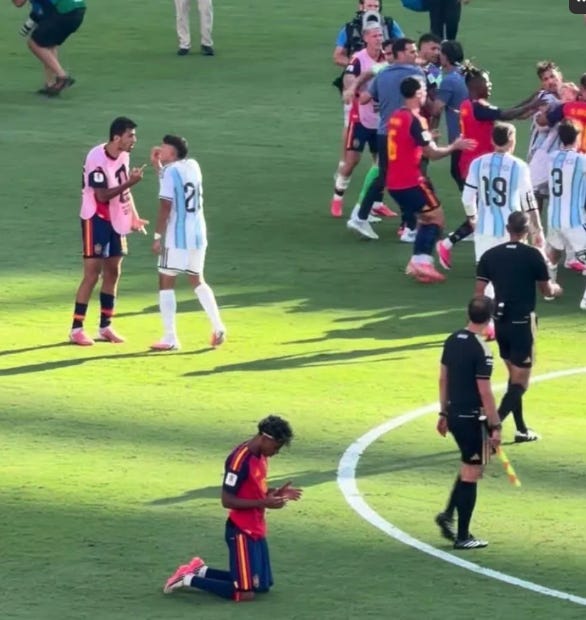
Don't share the picture if you're not ready to make the prostration

Last week, I used Tucker Carlson as a case study for how the Queen City Halaqa builds a semester from a single question. That was not only a demonstration of how I’d move from a student’s question to a semester-long course outline. This is me thinking out loud, reflecting on what I’ve done and adjusting for the year ahead. Applications for the 2026–2027 Queen City Halaqa are open. The class is already half full and we’re still six weeks out. How will this second year differ from the first?
Starting With Ibadah
Congratulations to the Spanish football team. I know many of my students were cheering for Lamin Yamal and Spain. I was, too.
I know lots of us shared the picture of him, the very image of poise and piety, on his knees in du‘a after the match, while chaos erupts around him. This is, indeed, admirable. But do you know what I felt when I saw that picture? Pride, yes. But also concern. Here’s a young man at the pinnacle of his career, with all the eyes of the world on him, and he put prayer first. How many of us actually do that? How many of us, when we are out in the world, would stop, drop everything, and pray, without any concern for what others think? If Lamin Yamal can do it, why can’t we? If we see this, and draw strength from it, and bring prayer into our lives, that’s great.
But if we share this, and that never goes any further, then why might that be? Courage is not the exclusive property of any particular individual. I can’t imagine a more potent confirmation of ‘ibadah, of permission to pray.
So what more do we need? What else are we waiting for? If we’re putting it off now, what’s holding us back?
Every session of last year’s Queen City Halaqa opened with salam and a du’a. Starting in the spring semester, I added a dhikr, the tasbih of Hadrat Fatima (RA), with one student leading and the rest of us following along, quietly. The more I sit with this, the more I believe this is the heart of the class. We have only two hours together on seven Sundays each semester. More of that time should go to ibadah. Learning is valuable, but we must be careful not to reduce that learning to a secular metric. How often, in other words, do our students get to experience Islam as faith? What can help us become men and women who so unselfconsciously and reflexively put God first?
What, in the end, is the heart of Islam if not our devotion to Allah? If we don’t want our deen to become identity, culture, or even community, we must remember and restore our connection with our Creator. The du’a and dhikr are not a warm-up before the “real” class begins. They come first because they ground us in the purpose of our lives. That’s not ‘ibadah in the stale sense ritual is often reduced to, but ‘ibadah as orientation, as a compass, which also reframes what we think of ritual, gives students a chance to engage in dhikr they might not otherwise do, and makes an epistemic point unique to Islam. There is no learning without fidelity to God.
If I skip that, if I rush through it, everything that follows doesn’t land. I’ve come to see this even after only a few sessions. The students might still learn something. But they won’t feel it days later.
After the du’a and dhikr, we have some unstructured time. Chips and salsa. Conversation. No phones, no laptops. This is where relationships form, the kind that make hard intellectual work possible, but that is, additionally, important on its own terms, that cannot be reduced. I’ll definitely keep this.
Then we move into the lesson itself: an interactive exercise, a reading, a debate, or just me teaching. That’s the architecture. But architecture without content is an empty building. And in an age when far too many people build ugly, generic, placeless buildings, don’t. What will I fill this semester with?
What else have I learned?
There’s More I’m Doing Differently
In my second post, I described reflecting on my students’ end-of-year evaluations. One thing they told me: I should answer their questions more fully, in ways that satisfy them. They were referring to how our spring semester had started. I’d asked them what about Islam made them pause, struggle, or doubt, and spent a significant portion of subsequent sessions on those questions. Not enough time, as it turned out.
This year, I’ve changed the questions. The application doesn’t just ask what students struggle with. It also asks
What they think a Muslim should know at their age,
What they want to accomplish over the course of the halaqa, and
What they’re most interested in learning
Don’t get me wrong. “What do you struggle with?” is important. I’m not abandoning it. But it’s deficit-framed. It positions the student as someone with problems the teacher will solve. “What should you know?” and “What do you want to accomplish?” put the onus on them: This is your halaqa too. Seven students have signed up so far. Here are three of the answers I received to that first question, What do you think a Muslim should know about her faith at your age?
At my age I believe a Muslim should know the basics of their faith. Including things like the Five Pillars of Islam, the importance of prayers and what the Qur’an teaches about lifestyle and character. They should also understand why we worship Allah, and why we treat others with kindness and respect, and continue to learn more about Islam as they grow.
They should know how to keep strong to their faith in challenging circumstances.
A Muslim should know the hardships that their fellow brothers and sisters had to go through.
I’ll draw on all of their answers, and those still to come, in designing the fall curriculum. My aim isn’t to flatten those differences into a single lesson plan. It’s to build a semester generous enough to hold all of them.
Of course, I also asked students to pick the focus they’re most interested in. The options included skills and content. Here are our results:
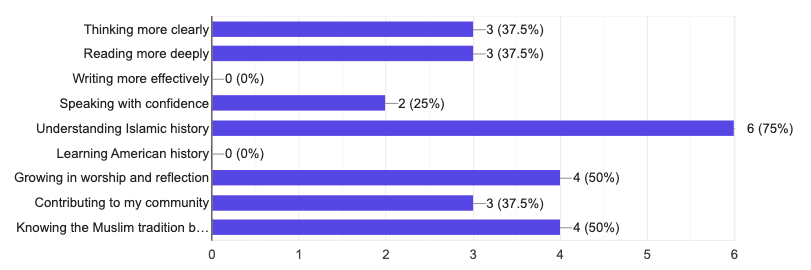
The students are telling me what they want to learn about. My job is to design a year where learning about Islamic history is also learning how to read carefully, think rigorously, and disagree well. The substance is the vehicle for the skills. And students will never ask for the skills directly, which is precisely why the teacher has to be intentional about embedding them.
I can’t pre-build an entire semester, of course. But I can prepare for one. I can make sure the du’a is ready, the space is set, the chips are on the table. I can carry into the room commitments about how I’ll teach: with rigor, with care, with honesty about what I don’t know. But there’s one commitment that sits underneath all the others. It concerns what happens when a teacher amplifies a voice, recommends a thinker, or cites a scholar. The responsibility that comes with that act, and how easily it can go wrong. I learned that the hard way as a young khateeb at NYU.
That story is what’s coming next week.
Building the Classroom
Each week here at Sunday Schooled, I share learnings you can apply to your own classrooms, inshallah.
Start With Worship, Not Content
If your students are going to think hard, disagree openly, and sit with discomfort, they need to be rooted first. Create conditions for stillness before you teach a single lesson. Du’a and dhikr are not formalities. They are the foundation. Everything that follows lands differently when it follows from spiritual grounding.
Reframe the Opening Question
“What do you struggle with?” and “What do you want to accomplish?” are both useful. But they produce different dynamics. The first invites vulnerability. The second invites agency. Consider asking both and notice how the answers differ.
Design for Skills Through Substance
Your students will ask for history, tradition, worship. They might not ask for critical thinking. That’s not a deficiency. It’s a signal about how learning works. Build the skills into the content so thoroughly that students are exercising them before they have a name for what they’re doing.
Beyond the Classroom
The Queen City Halaqa is part of a wider ecosystem of work: education, leadership, community. Here’s what’s unfolding.
Queen City Diwan: Applications Are Open
This is the second year I’m teaching the Queen City Halaqa; I’m building on everything I learned in our first: the trust-building, the student-driven curriculum, the rituals that ground us. The halaqa is open to Cincinnati-area Muslim high schoolers, capped at fourteen students. We meet on Sunday afternoons for two hours: worship, community, and rigorous intellectual engagement, without phones or laptops.
That Halaqa exists alongside a program open to young Muslim leaders, aged 18-24, from across the US, Canada and beyond. That might include your children, students or young professionals you know—and some of my readers. It’s the second annual Queen City University leadership retreat, this December 24–31, 2026, in Spain. Go thank Lamin Yamal in person.
Applications are now open for Muslim college students and recent graduates, ages 18–24, from across the US and beyond. The land package is just $2,500 per person for a week of immersive learning, mentorship, travel, and community. Some scholarship assistance is available. We have limited seats available and have already started receiving applications.
Husayn Day
How many Ashuras come and go and how many Sunni institutions can’t even bring themselves to note the martyrdom of the grandson of the Prophet Muhammad (ﷺ)?
Husayn ibn Ali (RA) is revered across our traditions. He is an icon of how much we share. He should be a model of courage and faith for every Muslim. But we don’t know how to talk about difference inside the ummah, which has gotten so bad that we can’t even bring ourselves to acknowledge who he is. I’ve been shocked, for example, that there are young Muslims who don’t even know who Husayn (RA) is. That’s painful to read, but it’s important to know.
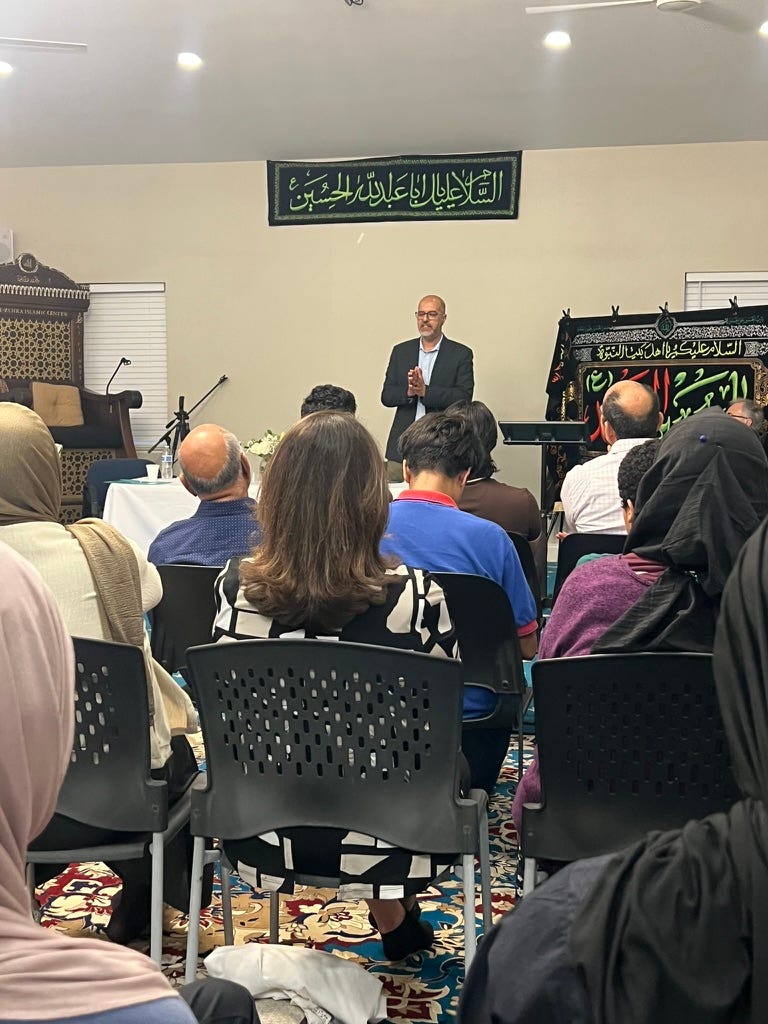
That’s why, last Friday, I spoke at Dar-e Zehra Islamic Center in West Chester, Ohio, for “Husayn Day,” an evening on the moral legacy of Imam Husayn alongside Dr. Cameron Zargar, a resident scholar at Dar-e Zehra, and Dr. Anas Malik, chair of Xavier’s political science department. Three speakers, three lenses, one shared question: what does Karbala teach us about moral red lines and the cost of standing for what’s right?
The evening was beautiful. A delightful dinner. Short talks. A Q&A session that ran long because the audience wouldn’t stop asking good questions. Families. Young people. The kind of room that reminds you what Muslim community can look like when we stop claiming unity and start building it.
Some of my Queen City Halaqa high school students have Shia family. We teach from the Sunni tradition, yes, because that’s what I know, that’s what I practice and that’s what most of our students are grounded in. But we respect the Shia tradition, not as a sidebar or diplomatic gesture, but because that is part of our ummah, we need to learn how to talk respectfully about difference, learn how to articulate what we choose, and learn how to engage and build across differences.
Of course, I’m not a scholar of Shia thought. I don’t pretend to be. Which is exactly why I invited my students to attend. One of them, alhamdulillah, did.
Queen City University, the program for young Muslim leaders 18-24 years old, operates on a broader model still. We invite diversity, Sunni, Shia, American and European, Middle Eastern, conservative and progressive, because difference inside the ummah is not a problem to be managed. It’s a depth to be explored. Dr. Zargar didn’t invite me despite the fact that I’m not Shia. He invited me because an evening about Husayn’s moral legacy should include the whole community that claims him.
I’m honored to be part of such a program and excited to watch it grow.
Avenue M: Get Rich or Die Tithing
This week on Avenue M, Joey and I went deep on the Prosperity Gospel, the theology that says God wants you to be rich, that if you tithe and believe, the blessing comes back in your bank account, your driveway, your annual physical. The Prosperity Gospel treats faith as transaction: believe correctly, receive accordingly. This is how many of us Muslims come to think about faith, even inadvertently.
We can’t help it, can we? It’s all around us. Joey and I wanted to understand where this theology comes from, what it promises, why it succeeds and where it breaks down. I brought in barakah, the concept that fidelity to God doesn’t promise you more but transforms your relationship with what you have. Joey pushed on whether Prosperity preachers even understand their own Protestant priors.
Watch the full episode on YouTube, or listen on Apple or Spotify.
On Reading History
Before you go, I wanted to share something special. A piece that captured the heart and soul of why it is we must teach our young men and women and why we must learn with them, too. In the New York Times this week, Charles King, a professor at Georgetown and the author of a forthcoming book on Gibbon’s Decline and Fall of the Roman Empire, wrote:
“Gibbon’s singular insight was that the whole point of reading a history book — or writing one — is not to come away with one big truth. The stealthy purpose of studying history is to get you comfortable with changing your mind.”
All three of my earliest applicants to the Queen City Halaqa asked for more about Islamic history. King goes further:
“Gibbon was skeptical that history had any definitive lessons. Corpses turned out to be terrible tutors. But knowing about the past, he believed, can help place the here and now in the proper light. Among other things, this knowledge improves our ability to live well by keeping us from mismeasuring the present. Praising our own times as a golden age, or mourning them as uniquely bad, are recipes for either disastrous overconfidence or paralyzing despair.”
If the point of studying history is to get comfortable with changing your mind, then what determines how we change our minds? What holds us steady while the ground shifts? The blessed Prophet (ﷺ) said: “Wisdom is the lost item of the believer; he picks it up wherever he finds it.”

Next week: a mistake I made as a young khateeb at NYU, what that error taught me about the weight of every word a teacher speaks, and why being conscious of what we amplify might be the most important thing an educator carries into the classroom.
Thank you for reading, keep sending your questions — they help me shape not only what I write here, but what I teach — and if you haven’t yet subscribed, here’s a great chance to
This was a good one.
Thanks, Haroon, for encouraging your students to attend Husayn Day. Tragically, some Sunni masjids shy away from talking about Ahl-Bayt. May we remember the martyrdom of Imam Husayn and emulate his life.